Blog
How India’s Infrastructure Needs Will Change by 2026
admin
January 30, 2026
In 2026, India’s infrastructure story will no longer be defined solely by expressways, ports, bridges, and power plants. The next wave of nation-building is shifting toward digital infrastructure, driven by India’s expanding digital ecosystem, AI and cloud-led industries, and long term national ambitions such as the Viksit Bharat 2047 vision.
At the core of this shift is a structural change: India needs not just infrastructure that connects places, but infrastructure that connects systems, capable of handling massive data flows, distributed compute, and real-time intelligence. Connectivity today isn’t defined by access, but by speed, reliability, security, and smart coordination between data and machines.
To understand how this shift plays out on the ground, we need to look at where infrastructure demand is changing the fastest. Three key layers are emerging as the new backbone of India’s digital-first economy.
1. The Rise of Smart, Connected Buildings
By 2026, residential and commercial buildings will be expected to function as digital environments, not merely physical assets.
As AI, cloud workflows, OTT consumption, gaming, and multi-device usage rise, buildings must operate as smart digital spaces rather than passive physical assets. Automation-led security, IoT-based energy systems, and utility-grade Wi-Fi are creating a new baseline for connectivity - one that traditional building infrastructure simply cannot support.
Legacy wiring, conventional broadband, and manual infrastructure planning cannot support this growing digital load. This is where in-building digital infrastructure becomes foundational.
Fibre backbones, IoT security, multi-operator connectivity, and continuous coverage are becoming essential infrastructure - fundamental to how buildings deliver value and experience.
Developers who recognize this early will gain pricing power, market differentiation, and long-term asset value. Those who don’t will face costly retrofits and lost competitiveness.
RANext operates at the core of this transition, enabling buildings to be future-ready from Day 1 through neutral, fibre-led digital infrastructure that supports high-performance and reliable connectivity.
2. Data Centers Evolve From Storage Hubs to AI Compute Engines
The second major shift is happening across India's digital backbone -within the data centers powering the country’s AI and cloud ambitions. According to an Economic Times report, India will emerge as one of the world’s fastest-growing data center markets, with capacity expected to cross 1.7 GW and hyperscalers investing over $60–70 billion in new facilities.
This growth is not being driven by storage alone. AI training and inference workloads are beginning to dominate compute, demanding ultra-high bandwidth, ultra-low latency, power-dense clusters, sovereign data frameworks, and distributed compute environments that work in real time.
For the first time, connectivity between data centers has become more important than connectivity within them.
This is where Constl steps in as a game-changer --providing AI ready, purpose-built digital infrastructure for enterprise grade connectivity that allows organizations to scale confidently.
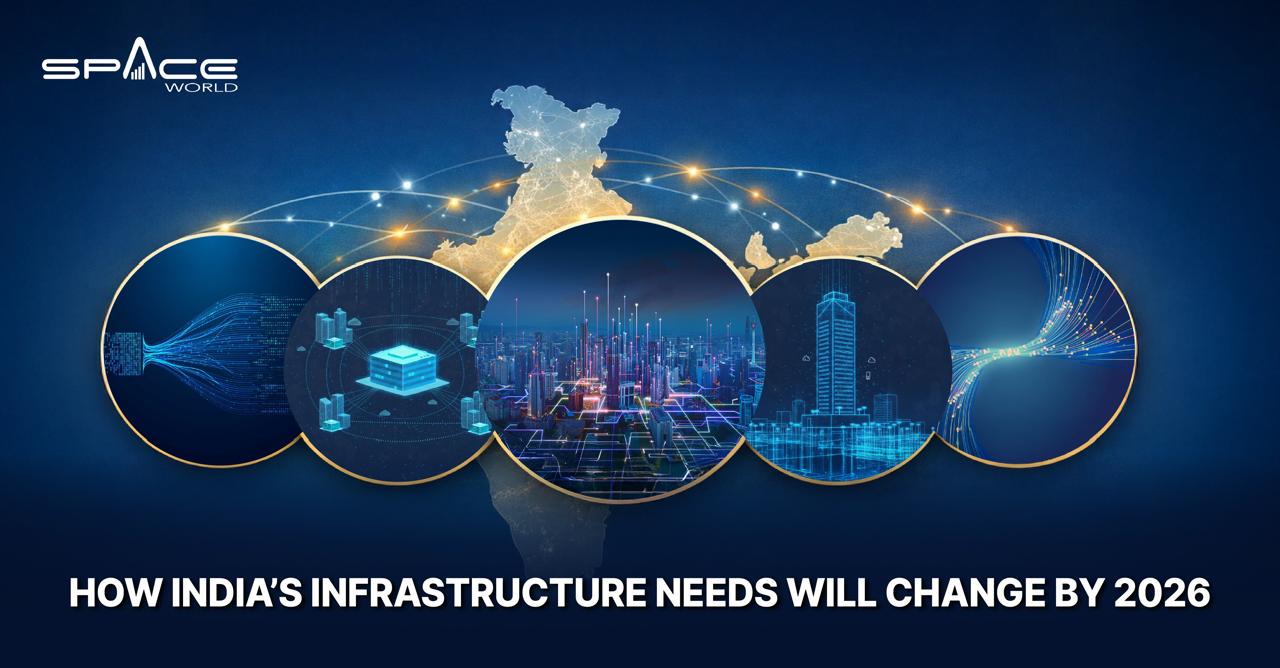
3. The New Infrastructure Trinity: Smart Buildings, Data Centers, and Fibre
India’s infrastructure stack consolidates into three interdependent layers:
|
|
|
|
|
|
|
|
|
|
|
|
|
|
|
|
Once these three layers converge, India unlocks the infrastructure required to power its AI economy, digital platforms, automated manufacturing, defence modernization, fintech scaling, biotech and R&D computing, and smarter urban mobility.
This is the real meaning of infrastructure in 2026 - not just concrete and power, but digital connectivity and cognition.
4. Infrastructure is Shifting From Passive to Intelligent
Space World Group sits at the intersection of this transformation - RANext making buildings digitally smart and Constl enabling data center interconnectivity, cloud and AI workloads through high-capacity, low-latency digital infrastructure.
These are no longer passive connectivity solutions - they are national digital infrastructure enablers, empowering the economy just as power and logistics did in the previous era.
Both divisions share a common view of where India’s infrastructure is heading. Connectivity will be defined by predictable performance - not by whether the internet works, but by how fast data moves, how consistently workloads run, and how resilient systems remain under load. Buildings will become network-native, with digital spines planned alongside civil and MEP work rather than as aftermarket add-ons. And as AI scales across industries, infrastructure will need to become coherent, enabling distributed computing to function as a unified system.
This marks the beginning of the decade of connected infrastructure. India is no longer just adding capacity; it is redesigning the architecture for a digital economy. Infrastructure is shifting from passive to programmable, from bandwidth to intelligence, and from redundancy to resilience. The future will favor nations that invest in digital infrastructure as seriously as they do in roads, power, and transport. India is finally doing both.